
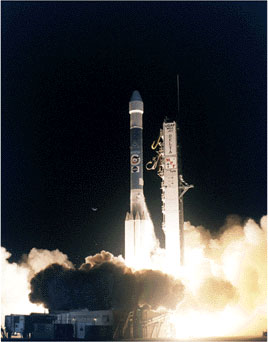
The Delta II launch vehicle performed flawlessly, placing the spacecraft on its trajectory to Mars well within acceptable limits. NASA's Deep Space Network acquired the spacecraft telemetry signal on schedule, about five minutes after separation of the delta's third stage. When Pathfinder came out of Earth's shadow at one hour and 38 minutes after launch, the solar arrays took over powering the spacecraft as planned. "Power from the array looks to be about 10% better than initially predicted," said Muirhead.
Over the next few days, however, Pathfinder engineers continued to analyze data from the spacecraft's Sun sensor, an instrument that helps the spacecraft determine its orientation with respect to the Sun. "The sensor's voltage output is below expected levels, but it does appear to be giving good data," said Muirhead. Navigation data and the Sun sensor data agreed and showed the spacecraft to be properly oriented, spinning at the expected 12 rpm and pointed 26 degrees away from the Sun. Later during the week, Muirhead said the spacecraft was commanded to switch to a redundant sensor head to see if it was also performing at a low voltage. This turned out not to be the case.
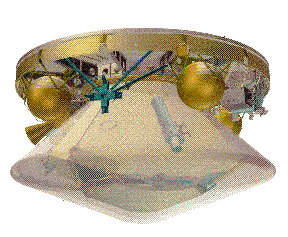 Carried inside the cone-shaped spacecraft is Sojourner, the
small robotic rover that will roll out and traverse the local surface of
Mars when the spacecraft makes its Martian landing on July 4, 1997. It will
be the first spacecraft to land on Mars since NASA's Viking mission soft-landed
two spacecraft there in 1976. Pathfinder is the second mission in NASA's
Discovery program, which is designed to send low-cost spacecraft with highly
focused mission objectives to explore space. Several weeks after launch,
the Mars Pathfinder team successfully updated attitude control software
to further compensate for the apparent obscuration of the Sun sensors. Miguel
San Martin, lead Attitude Control Subsystem Engineer, stated, "This
software update should allow the spacecraft to perform all turns and maneuvers
needed to get it to Mars. We are very pleased with the subsystem's performance
in spite of the Sun sensor obscuration."
Carried inside the cone-shaped spacecraft is Sojourner, the
small robotic rover that will roll out and traverse the local surface of
Mars when the spacecraft makes its Martian landing on July 4, 1997. It will
be the first spacecraft to land on Mars since NASA's Viking mission soft-landed
two spacecraft there in 1976. Pathfinder is the second mission in NASA's
Discovery program, which is designed to send low-cost spacecraft with highly
focused mission objectives to explore space. Several weeks after launch,
the Mars Pathfinder team successfully updated attitude control software
to further compensate for the apparent obscuration of the Sun sensors. Miguel
San Martin, lead Attitude Control Subsystem Engineer, stated, "This
software update should allow the spacecraft to perform all turns and maneuvers
needed to get it to Mars. We are very pleased with the subsystem's performance
in spite of the Sun sensor obscuration."
At 7:40 p.m. PST on January 9, 1997, the team successfully performed its first and largest trajectory correction maneuver (TCM-1). This maneuver, planned by lead Flight Engineer Rob Manning, used two of the spacecraft's eight 1-pound (0.45-kg [4.4 N]) thrusters. These thrusters fired continuously for an hour and a half to change the velocity of the spacecraft by 31 m/s (69 mph). The purpose of this maneuver was to correct small launch vehicle targeting errors and reduce the planetary protection trajectory bias. Later, the team turned the spacecraft's spin axis 35 degrees back toward Earth so that radio navigation could be performed more effectively.
Then, at 5:00 p.m. PST on February 3, 1997, the Mars Pathfinder team successfully completed the spacecraft's second trajectory correction maneuver (TCM-2). This maneuver was designed to correct errors in the first TCM, performed on January 9, and move the craft closer to its final trajectory. The spacecraft will not be placed on a Mars atmospheric entry trajectory until after TCM-3 (currently scheduled for May 6) because of planetary quarantine requirements. The TCM-2 design team, led by Flight Engineer Guy Beutelschies, developed a two-part approach to perform the maneuver. In the first part, the spacecraft fired two of its forward-facing thrusters continuously for 5 minutes. The change in velocity for this "axial" component was about 1.5 m/s (3.4 mph). The second part of the maneuver was a smaller velocity correction of 0.1 m/s (0.2 mph) performed in the "lateral" mode. In this mode, the spacecraft pulsed all four thrusters on one side of the spacecraft for 5 seconds. This pulse caused a small change in the spacecraft velocity in the direction perpendicular to the spacecraft spin axis. This mode will be used for all future maneuvers, so TCM-2 was a good proof-of-concept test.
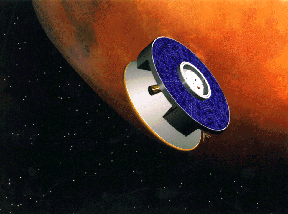 Upon completion of the maneuver, the spacecraft's
spin axis was turned 15 degrees back toward Earth so that radio navigation
could again be performed more effectively. The spacecraft is currently pointed
about 5 degrees from Earth and 2 degrees from the Sun.
Upon completion of the maneuver, the spacecraft's
spin axis was turned 15 degrees back toward Earth so that radio navigation
could again be performed more effectively. The spacecraft is currently pointed
about 5 degrees from Earth and 2 degrees from the Sun.
The spacecraft will remain in a relatively quiescent
mode for the next 2 to 3 months. The flight team is currently working hard
to complete planning for Mars entry and surface operations. Currently, flight
software testing is progressing well for entry, descent, and landing. The
Flight Software Testing team completed an airbag retraction test in the Building
230 Sandbox on March 14, 1997, and finished a
set of parachute deployment and rocket ignition algorithm robustness tests
on March 21, 1997. A couple of significant issues noted in this testing
are likely to cause the team to change the spacecraft's flight software.
A flight software change board meeting was held on April 1 to determine
what changes to make and what regression tests to perform.
--Richard Cook, Mars Pathfinder Mission Manager