
TES Engineers Show Their Stuff
MGS Instrument Featured at Teacher Workshop by Hughes and Arizona State
University
We were disappointed two and a half years ago when Mars Observer was
lost. Our project, the Thermal
Emission Spectrometer (TES), was one of the seven instruments onboard
the lost spacecraft. Months before the mission launched in September 1992,
we had started an education outreach program to share the TES experience
with teachers and students in Arizona. When we began the program, we realized
it would have been really great if we had started it earlier, and given
people a chance to see what goes into the building and testing of a spacecraft
instrument before it gets launched. One of the positive things to come out
of the loss of Mars Observer-- we now had the opportunity to share the process
of putting together a TES instrument.
"Seeing is believing!" exclaimed a Santa Barbara teacher who was
among the 35 K-12 teachers who came on Saturday in January to the new TES
being manufactured for Mars Global
Surveyor. The TES is being built by the Hughes, Santa Barbara Remote
Sensing company in Goleta, California (just outside Santa Barbara) by a
dedicated team of men and women. SBRS is a new name-- just recently they
changed from SBRC, for Santa Barbara Research Center. SBRC built the original
TES that was on Mars Observer; they also have a long track record of building
infrared instruments for the Viking and Mariner Mars missions of the 1960's
and 1970's.
The teachers who came to Goleta to see the new TES learned about the instrument
and Mars Global Surveyor mission from the Arizona Mars K-12 Education Program
and TES Principal Investigator, Philip Christensen of Arizona
State University. The group learned that TES will be able to "see"
infrared light emitted by Mars at wavelengths between 6 and 50 micrometers
(a micrometer is 1000 times smaller than a millimeter). These observations
will allow geologists like Phil Christensen to figure out what kinds of
rocks and minerals are on the surface of Mars.
Geologists use minerals and rocks to interpret the history and evolution
of a planet. For example, on Mars the detection of limestone (a calcium
carbonate rock very common in the U.S. midwest and in Florida) might indicate
that the Red Planet once had lakes or seas. Every mineral has its own unique
infrared "color." By looking at the spectrum of infrared light
emitted from the surface of Mars, the TES will obtain spectra that provide
the information needed to figure out which minerals occur on Mars. Phil
Christensen showed the educators who attended the workshop a variety of
examples as to how scientists are already using infrared images of the Earth
to decipher geologic history and infrared spectra to identify minerals.
Christensen told the group that he got the idea back around 1984, while
he was a research assistant at Arizona State University, to propose the
TES instrument to NASA for the Mars Observer mission. Christensen put together
a team of scientists from around the country, and got them together with
engineers at SBRS (then SBRC), because, when it comes to making infrared
spacecraft instruments, he said, "they are the best in the business."
Christensen's science team included both geologists and atmosphere scientists.
Besides looking at minerals, TES can take the temperature of Mars' surface,
provide information about the temperature and pressure of the Martian atmosphere,
help scientists figure out what the clouds (dust and ice) are made of, and
monitor the seasonal changes in the polar ice caps. From the nearly 400
km orbit of Mars Global Surveyor, TES will have a ground resolution of about
3 kilometers.
After hearing about TES and Mars Global Surveyor, the teachers who came
to Goleta for the workshop piled into cars and drove to SBRS for a tour.
They were greeted by SBRS personnel George Cannon, Margaret Finlay, Marty
Greenfield, Jeff Parker, Steve Silverman, Jack Weber, and Steve Young. The
SBRS people took time out of their busy schedules (busy preparing the TES
instrument for Mars!) to show off their work. For example, SBRS engineer
Steve Silverman has played a key role in engineering the TES. When the group
visited Silverman, he was standing next to the TES instrument, which was
inside a Plexiglas chamber to protect it. Silverman and
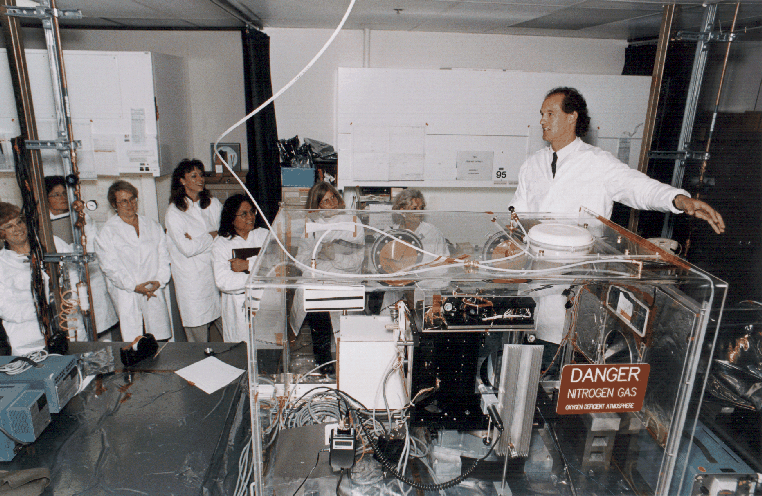
SBRS engineer Steve Silverman (right) explains Mars Global Surveyor's
Thermal Emission Spectrometer. TES is inside the Plexiglas chamber (foreground).
Hughes SBRC Photo 96-1-103-14
Christensen, who have worked very closely on this and the earlier TES
instrument, both looked like proud fathers introducing their new baby. One
teacher noted that seeing the instrument and talking to the people involved
with the project gave her a new "perspective on what a project such
as this involves." Another remarked that it was a great opportunity
"to see behind the scenes work."
Having Hughes SBRS open its doors and letting a group come in to see an
actual instrument being prepared for flight to Mars was a rare and unusual
treat. This point was not lost on the educators, one of whom remarked that
it was great "to see so many people excited about the work they are
doing." Another, who had traveled from Chandler, Arizona, to see the
Mars Global Surveyor TES, said that she was "very impressed and very
excited" and couldn't wait to share what she had learned with her students.
Many teachers were surprised to learn how hard the SBRS engineers work--
sometimes 80 hours a week for a 40-hour paycheck-- because they are excited
about the TES project and dedicated to delivering a quality instrument on
time.
TES is scheduled to be taken to Denver at the beginning of April. It will
be attached to the Mars Global Surveyor spacecraft at Lockheed-Martin in
Denver. MGS will launch in November and reach the Red Planet in September
1997. The TES team will anxiously await the new data from Mars, and teachers
and students around the U.S. will continue to be involved in the process.
Educators can request more information about TES and the Arizona Mars K-12
Education Program, by writing on school letterhead: K. Edgett, Department
of Geology, Arizona State University, Box 871404, Tempe, AZ 85287-1404.
Also visit the WWW site at http://esther.la.asu.edu/asu_tes/.
--Ken Edgett
Arizona State University