
"Mars On $300K A Day": The Mars Exploration Program
The Mars Exploration Program is pioneering a series of "better,
faster, cheaper" missions to Mars over at least the next 10 years,
and possibly well into the 21st century. The overall cost of the program
is somewhat over $100M per year, including launch vehicles and operations,
for two launches every 26 months. (This works out to about $300K per day).
A programmatic strategy has been developed involving selection of a science
theme for the program, a long-term industrial partnership for spacecraft
development, continuous infusion of new technology, and integration of the
individual projects into an overall program so that synergy between projects
can be maximized. A number of process improvements have been made in procurement,
concurrent engineering, rapid prototyping, and integrated payload selection,
among others.
Program Description
The Mars Exploration Program Office was formed at the Jet Propulsion Laboratory
in July 1994 to integrate the robotic exploration of Mars. The two major
elements of the program are Mars Pathfinder
(one of the first two Discovery missions) and the Mars Surveyor Program
(a program to send missions to Mars every opportunity within severe cost
constraints). The Mars Surveyor Program was established in the wake of the
loss of Mars Observer in 1993. The first of its missions, Mars
Global Surveyor, will carry six of the eight Mars Observer Instruments,
and the other two instruments are planned to be flown in 1998 and 2001.
The Mars Exploration Program will continue the investigation of the red
planet by robotic spacecraft which began in 1965. The new U.S. program of
exploration will begin with launches in late 1996 of the Mars Global Surveyor
and Mars Pathfinder missions and extend through at least 2005. And studies
are underway for activities leading up to a human mission to Mars as early
as 2018. The focus of the first 10 years of the Mars Exploration Program
is on building knowledge steadily and incrementally to a thorough characterization
of the planet in terms of life, climate, and resources.
Mars Global Surveyor will be launched in December 1996 (also on a Delta
7925), and will go into orbit around Mars in September 1997. After that,
the Mars Surveyor program will fly two missions to Mars every opportunity
(about every 26 months). The Pathfinder and Mars Surveyor Programs are pioneering
the "better, faster, cheaper" approach to planetary missions.
In late 1998 Mars Surveyor 1998 will launch an orbiter and a lander on a
Delta 7325 launch vehicle (LV) (cheaper than a Delta II). The orbiter will
carry an infrared spectrometer to survey the atmosphere over a Martian yearly
cycle (1.88 Earth years). The lander will place a payload near the south
pole to search for volatile elements such as water.
The final element of the lost Mars Observer payload (a gamma ray spectrometer)
is being considered to search for water in 2001 on the Mars Surveyor 01
orbiter, and another (planned) landed payload will have a rover investigate
an ancient highland lake bed to study the climate history of the planet.
One of the 2001 missions may be conducted in partnership with the Russians.
For the 2003 opportunity the Mars Surveyor program is exploring a partnership
(InterMarsNet) with the European Space Agency to place three landers on
the surface. And the Mars Surveyor 2005 mission will be part of an attempt
to return a sample from the Martian surface.
Over the next 10 years the Mars Exploration Program will result in a detailed
understanding of Mars, which is of interest not only to Mars scientists
but will help in understanding more about the earth's environment, and can
eventually provide the basis for human exploration. The entire program will
be conducted for about one-third the (inflation adjusted) cost of the Viking
missions which orbited and landed on Mars twenty years ago. Each mission
costs about the same as a major motion picture, and the total cost of 10
missions to Mars is about the same as that of a couple major military aircraft.
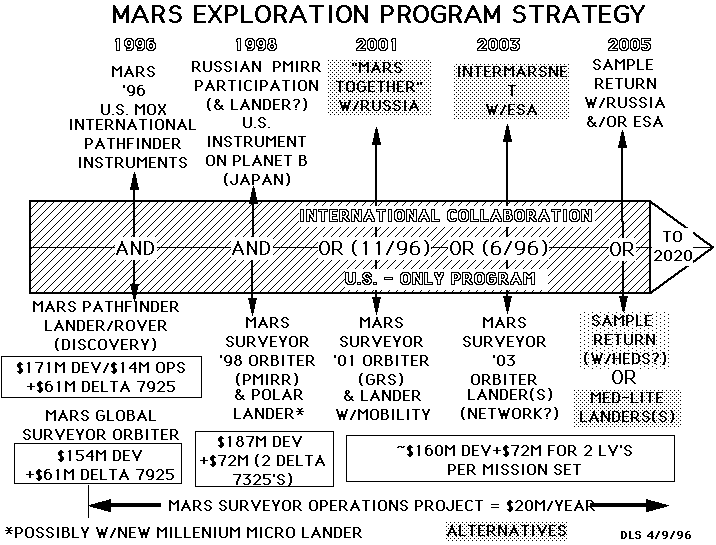
Figure 1 graphically illustrates the program-including a U.S. only mission
set (on the bottom)-which can be augmented by international partnerships
(on the top). Each launch year is shown across the top from 1996 through
2005.
The funding available for each mission is shown in the boxes in real-year
dollars: the first number is development cost, the second is launch vehicle
cost. (The assumption here is that Delta 7325's cost only $36M each, but
this may not be the case when the "Med-Lite" contract is finally
negotiated). For Pathfinder a $14M operations cost is shown for the 7-month
cruise and a year of surface operations. For the Mars Surveyor Program a
project has been formed to operate all the missions, and there is $20M per
year available for this (not including tracking and data acquisition costs
of the Deep Space Network).
Strategic Planning - Thinking Like a Business
Because the new Mars exploration missions were to be conducted at only a
fraction of the cost of previous missions, cost became the major driver-with
performance and risk being the dependent variables-a major paradigm shift
for NASA missions. Consequently, it was decided to approach planning for
the program as though it were a business.
A diagram of the approach is shown in Figure 2, mapped as a series of
questions.
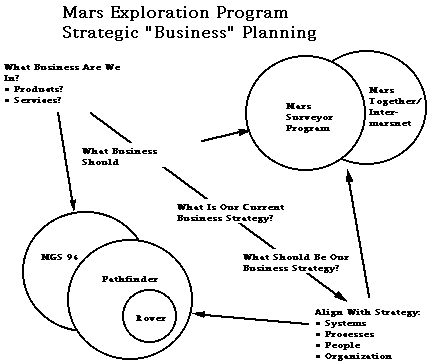
Since Mars Global Surveyor and Pathfinder (including the rover technology
experiment being funded by NASA's technology program) were in existence
when the Mars Exploration Program was formed, they were our "current
business". Businesses of the future were the remainder of the U.S.
Mars Surveyor Program, plus international missions which could augment Surveyor.
We investigated several "businesses" which we must be in to conduct
a program of Mars exploration in today's environment, and arrived at five:
knowledge generation, exploration, education, inspiration, and technology
development/transfer. For each business we identified the customers, and
specific products and services which we would be providing these customers.
We identified how we were currently meeting the needs of these customers,
that is, what our current business strategy is. Then we identified what
our business strategy should be to meet the customer's needs. We selected
which businesses should be our primary focus, and which should be primarily
carried out by "partner" organizations at JPL. We identified the
systems, technology and processes needed to carry out our business strategy.
Then we staffed the program office, and finally, we evolved an organization
to conduct the selected businesses.
Figure 3 shows the selected "businesses" with their descriptive
information (summarized).
| Figure 3: Mars Exploration Program
Business Analysis (Summary) | | Business |
Product | Technology in Product | Technology
to Produce Product | Features of Product | Customers |
| Knowledge | Information about Mars | Information management | Mars
Missions | Understandable information | Scientsts, everyone |
| Exploration
about Mars | Information management | Infomation Missions | Mars
information | Synthesized | NASA |
| Education | Educational
products | Infomation presentation | Translation of knowledge | In
curricula | Educators, students |
| Inspiration |
Inspiring information | Information presentation | Computer
graphics, etc. | Exciting | The public |
| Technology
Development & Transfer | Advanced technology | Technology
itself | Techniques for technology production | Cost effective | Missions,
industry |
This business analysis showed us that the "Knowledge" and "Exploration"
businesses were very similar in terms of the missions needed to produce
the knowledge products. These knowledge products (an understanding of Mars,
plus knowledge about the technology and processes of conducting missions
to Mars) could be produced synergistically by current and future Mars Exploration
Program missions, provided the missions were conducted properly. If the
information received from the missions can be synthesized and translated
into products suitable for the classroom, the needs of the "education"
business can be met. And if the information is presented in a clear and
exciting way, the Mars Exploration Program can provide "inspiration"
to the public.
Since the only way to conduct a series of Mars missions on the very low
budgets allocated is to use new techniques, processes and technologies,
the "technology" business becomes a by-product of the knowledge
and exploration businesses. The step of transferring technology developed
or transformed by the Mars Exploration Program is needed to infuse that
technology into other applications (preferably commercial).
Part Two of this business strategy will be discussed in the next issue of
the Chronicle. Stay tuned!
--Donna Shirley